

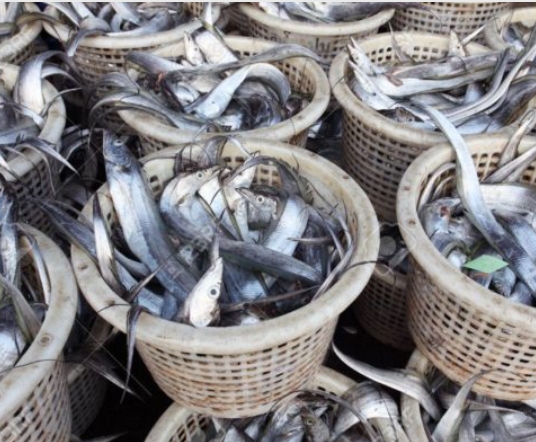
Driven by economic hardship and soaring costs of power and ice, some fresh fish sellers across Nigerian markets are now brushing industrial red dyes into decaying fish to make them appear fresh, a practice health experts say poses serious health risks.
Investigations reveal that the unwholesome practice, common among small-scale traders, involves applying chemical dyes to the dull, grayish gills of day-old or spoiled fish to give them the vibrant, crimson look associated with a fresh catch.
In nature, fish gills turn from bright red to dark brown or pale gray shortly after death as oxygen leaves the blood. Fraudulent vendors are exploiting consumers’ belief that “red gills equal fresh fish” to mark up prices and avoid losses.
Health practitioners have warned that the chemicals used are industrial-grade dyes containing heavy metals and toxic compounds.
“What we are witnessing is not just economic fraud; it is a calculated threat to human life,” said Dr. Hassan Abdullahi, a health practitioner.
“These sellers are prioritizing profit over safety. Consuming fish tainted with these chemicals can lead to acute gastrointestinal destruction, severe food poisoning, and potentially permanent kidney and liver damage.”
Caterer Mrs. Yemisi Dauda described how the dye is applied: “These chemicals were being meticulously brushed into the dull, grayish gills of day-old or decaying fish to give them the vibrant, crimson appearance of a morning catch.”
Several traders and consumers blamed worsening economic pressures as the main driver of the practice.
With skyrocketing electricity tariffs, many vendors say ice production and refrigeration have become too expensive to preserve unsold stock overnight. Rather than discard spoiled fish, some resort to the chemical cover-up to sell at premium prices.
Mrs. Josephine Audu, a caterer, narrated her experience: “Last weekend, I bought some red snapper that looked beautiful at the stall, but when I got home and submerged it in water, the gills completely lost their color and the water turned bright red. The fish smelled terrible underneath. We truly have to be detectives just to feed our families safely now.”
Civil servant Mrs. Sherifatu Kazeem said: “For years, the number one rule my mother taught me when buying fish was to look for bright red gills. Knowing that criminals are now weaponizing that exact rule to poison us for profit makes me want to stop eating fresh fish altogether.”
Chef Mabel Ajede urged consumers and restaurant owners to look beyond gill colour.
“I always tell my kitchen staff to smell the fish and check the firmness of the scales, not just look at the gills. If you wash a fish and the water runs pink or red, throw it out immediately! It is a scam and a health hazard,” she said.
Trader Mrs. Fatimetu Dirisu described the trend as criminal but also a reflection of infrastructural failure.
“When electricity and ice become too expensive for everyday market women to preserve their goods, desperation sets in. We need solar-powered cold stations in our markets to help honest traders preserve food safely without turning to crime,” she said.
Health authorities are yet to comment on possible regulatory action, but experts are calling for increased market surveillance and affordable cold-storage solutions to curb the dangerous practice.
(Vanguard)


