

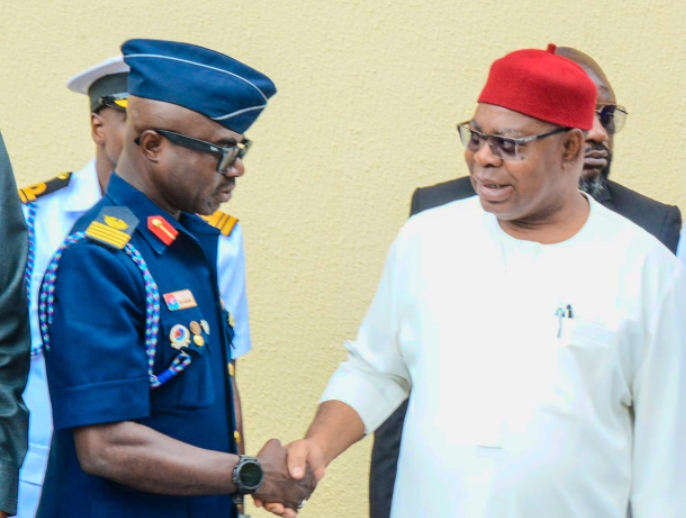
Governor Sheriff Oborevwori of Delta State has advocated for a decisive shift toward intelligence-led, preventive, and collaborative security governance to tackle Nigeria’s evolving security challenges.
He made the call on Monday during a visit by participants of the Advanced Intelligence Officers’ Course 16/2026 from the Defence Intelligence College, Karu, Abuja.
The Governor who was represented by his Deputy, Sir Monday Onyeme, Ph.D., highlighted the critical role of integrated intelligence and multi-agency coordination in safeguarding national assets and regional stability.
He said, “the security problems confronting Nigeria demand a decisive shift from reactive security management to preventive, intelligence-led and collaborative security governance. Intelligence must translate into timely decisions, effective action and measurable security outcomes.
“I urge you, as future senior intelligence and security leaders, to use the knowledge and experiences gained from this tour to strengthen national resilience and promote greater cooperation among security institutions.
“This is because, I am very happy to welcome you to Delta State on this important study tour, themed, “Strengthening National Resilience Through Integrated Intelligence, Multi-Agency Coordination and Regional Security Cooperation.”
“I am particularly pleased that Delta State was chosen for this study tour. Delta occupies a strategic position in the Niger Delta as an oil and gas hub, maritime gateway and agricultural belt.
“Security and stability in our State have implications for the wider Niger Delta, the protection of critical national assets and the economic security and sustenance of Nigeria.

“Government recognises that contemporary security threats require collaborative engagement rather than isolated responses; we have therefore continued to strengthen cooperation among the Army, DSS, Police, Navy, NSCDC and other relevant stakeholders, while providing necessary logistical support for security operations.”
“The Operation Delta Sweep was established to strengthen joint security operations, reduce crime and protect lives and property through coordinated action.
“Similarly, the regular State Security Council meetings provide a platform for government and security agencies to assess emerging threats, share intelligence and coordinate appropriate responses.
“In addition, Government established the Office of the Special Adviser on Peace Building and Conflict Resolution to prevent and resolve conflicts, promote reconciliation and foster peaceful coexistence, while the Office of the Special Adviser on Intelligence Gathering strengthens grassroots intelligence and proactive crime prevention, among others.
“Delta State also recognises the importance of intelligence from the grassroots; traditional rulers, Presidents-General, community development structures and other community stakeholders play vital roles in providing early-warning information that supports timely security intervention.
“Only recently, a security summit with the theme: “Security: A Collective Responsibility” was organized by the State Government and it saw stakeholders uniting against terror and all forms of criminality.
“Following 2026 Delta State Economic and Investment Summit, we are also developing a Data and Investment Intelligence Hub to support the collection, integration and analysis of reliable data for evidence-based decision-making, economic planning, investment promotion and security management.
“At the regional level, Delta State continues to pursue regional security cooperation through platforms such as the BRACED Commission and the Niger Delta Governors’ Forum, particularly in addressing cross-border threats such as kidnapping, cultism, illegal bunkering and maritime insecurity,” the Governor said.
Earlier, in an address, the Team Leader, Commodore Usman Bugaje, disclosed that the choice of Delta State for the study tour was because the state is very strategic to the economy of the country.
According to him, “we considered the economic importance of Delta State, particularly its economic activities, offshore operations, transportation corridors, movement of finished products, crude oil, and the oil and gas industry, among others.
“We also considered the various security agencies operating in the State.
“The participants are here to interrogate and examine the peculiar security challenges affecting the State, in line with the theme of the course, which focuses on strengthening national resilience through integrated intelligence, multi-agency coordination and regional security.”
“Basically, we are here to engage with the citizens of the State, appreciate the efforts of the security agencies, and hear first-hand about the efforts of the State Government in bringing together the various security agencies, including traditional institutions, towards achieving relative peace and security in the State.”


